Pages: 1.1 Welcome --- 1.2 One Team, Many Roles --- 1.3 Format Concepts
¶ Format Concepts
These are some basic format concepts which I'll be referencing throughout my format guides.
¶ Stages/Phases and Progressions/Advancements
Competitions often consist of more than just one bracket or bracket type.
For example, a competition might start with round-robin and then end with a single-elim bracket.
I refer to these as the 'stages' of a tournament; you'll see these referred to as 'phases' on certain bracketing software.
Moving competitors from one stage to the next is what I call 'advancing' or 'progressing'.
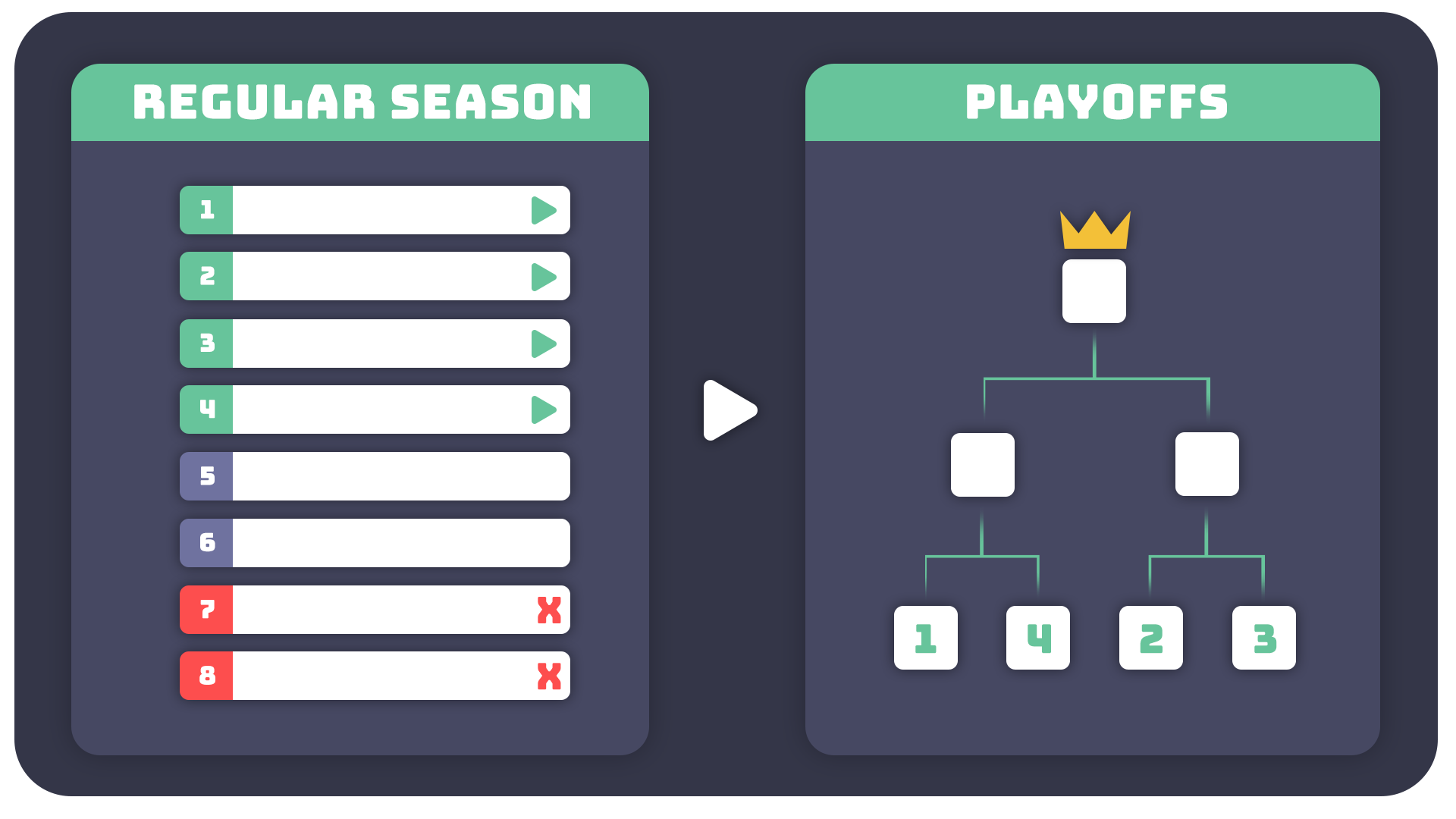
We see both of these concepts all the time in traditional sports:
a team 'making the playoffs' means that they advanced from one stage (regular season play) to another stage (the playoffs bracket).
¶ Groups/Pools
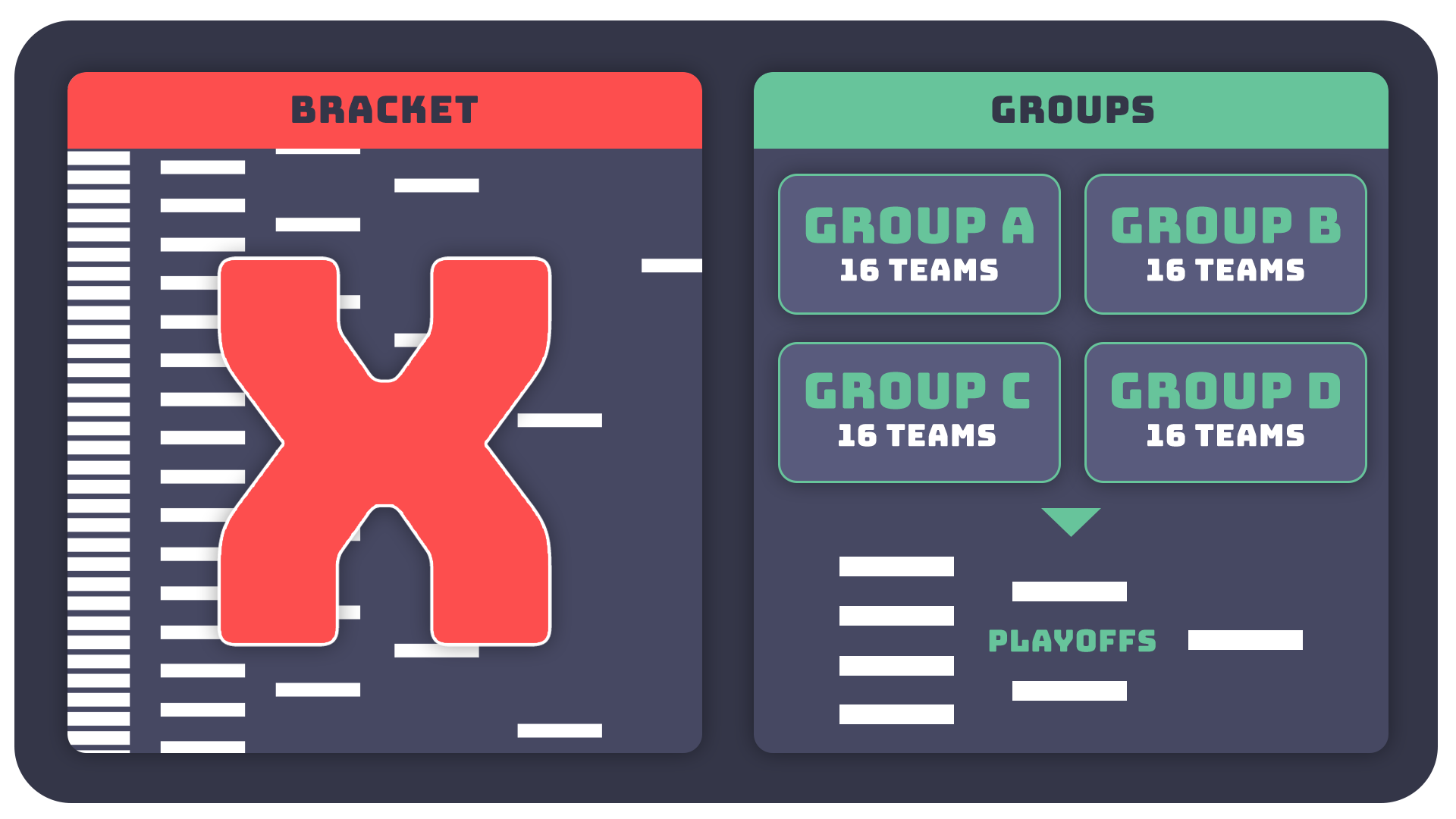
As the number of competitors scales, competitions are usually broken up—visually and/or functionally—into distinct groups.
Imagine trying to read through a gigantic double-elimination bracket of 512 competitors (spoiler: it's an eyesore).
And, if it's an in-person event where the number of setups (the hardware the game is played on) is limited, then how would you schedule out when & where each match is happening?
For easier digestion and logistics, a large competition can instead be divided into several, digestable groups (also known as 'pools') which feed into a smaller group.
As an example: let's say we take that 512 competitor bracket and draw it up as 16 groups of 32 competitors each (16 groups × 32 per group = 512), where the top two competitors per group advance to a 'final' bracket (16 groups × 2 advancing per group = 32 competitors in the final bracket).
You could then schedule these 16 groups into specific time slots on specific setups, assign specific staff to run each of them, and focus on the storyline within each individual group when you broadcast matches ("Who's going to advance out of this group?").
Neat!
The exact number of groups, and how many advance per group, is subjective.
The ultimate goal is that Competitors, Competitive Ops, Broadcast, and fans can all easily manage and understand whichever piece of the overall puzzle they're currently focused on.
For some formats, like round-robin, the act of dividing competitors into separate groups will actually change how many matches are played, and what those matches are.
Using groups, in those cases, is done to adjust runtime/scheduling and the story/structure.
¶ Seeding
Seeding has multiple meanings.
- Seeding, as a noun, is the starting positions of competitors in a competition.
It can universally be represented as an ordered list going from Seed 1 to Seed n (for n competitors).
A competitor's 'seed' is their position on this list: 1st seed, 5th seed, 17th seed, etc.- In a bracket, a competitor's seed determines which 'slot' of the bracket they start in.
- In round-robin groups, a competitor's seed determines which group they are placed into.
- In Swiss, a competitor's seed is their pairing number.
- Seeding, as a verb, is the act of sorting competitors from highest skill to lowest skill to produce the ordered list.
Once this sorting has been performed, that seeding is then 'applied' to place competitors into their starting positions.
Seeding plays a crucial role for any competition because it determines the path each competitor must take towards victory.
'Accurate' seeding means that competitors are correctly sorted from highest skill to lowest skill, and should result in a fair competition.
'Bad' seeding would mean that competitors are not sorted correctly, and can lead to painful situations (usually involving top competitors eliminating each other earlier than they should).
These adjectives are subjective, but usually have elements of objective basis to them.
A well-seeded competition usually starts with more 'imbalanced' matchups, and then progresses into closer and closer matchups.
In each format guide, I will touch on how that format interacts with seeding.
Some formats are heavily reliant on accurate seeding, some formats are not, and
some formats are actually well-suited to determine accurate seeding for subsequent stages.
¶ Bracketing Software/Tournament Tools
Unless you're doing things by hand (or in a private spreadsheet), you'll likely make use of bracketing software.
Popular choices include:
In general, these tools offer invaluable features such as:
- A webpage for your tournament's information, bracketing, and results
- A way for competitors to register for your competition
- A means of seeding the competitors
- A means of generating brackets
- For certain formats & event sizes, this is imperative because doing so by hand would be impractical or error-prone
- A means of entering results & automatically progressing competitors to their next matches or stage
Each software/tool boasts its own strengths and weaknesses, and supports different formats in different ways.
Certain games communities have built their own software for their particular needs.
Picking the right tool for your project can save you a great deal of effort and prevent problems, so make sure to research and carefully consider your options!